Dear 1L, Everyone I’ve spoken to is dying, writing a brief for the first time, self-doubting, second-guessing,
triple-stressing ❗️
It’s way harder than planned, too, prompting:
—what’s wrong with me?
—why’s it taking me so long?
—is anything I’ve done right?
—does this mean I don’t belong?
Please know
—all of these feelings are NORMAL for 1Ls this time of year;
you are not alone in your struggles;
and you WILL get through.
But to make it easier for you, I’m sharing my 3 golden rules for briefs.
♦️ No. 1:
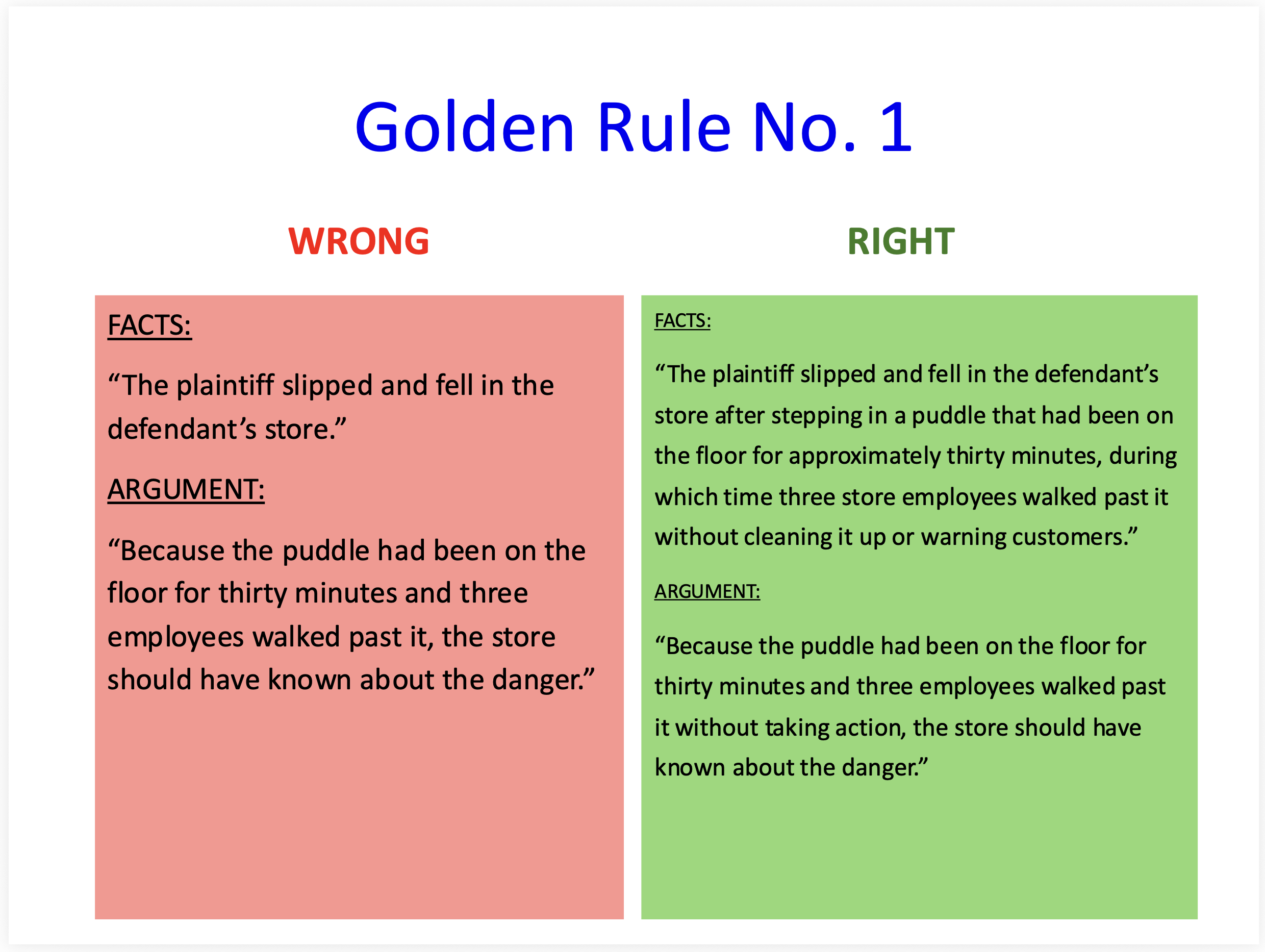
You can’t use any fact in the “Argument” unless you have described it in your “Facts” section.
👉 Think of each fact as evidence, and the “Facts” section as the official record for the case.
If something’s not stated in the record (your “Facts”), you can’t use it in your Argument.
—See example in first slide—
♦️ No. 2:
You can’t use a fact from a court case in CREAC “A,” unless you have described it in the CREAC “E”.
Every fact and other relevant detail about a case needs to be explained in a non-argumentative way (in the “E” part of CREAC).
Do that BEFORE you compare the case facts to the facts in your hypothetical (in the “A” part of CREAC).
👉 If it’s not in your “E,” it can’t be in your “A.”
—See 2nd slide—
♦️ No. 3:
A case is only helpful to a party if that case came out favorably for your similarly situated party.
(This is the dicta rule from “Dear 1L” ch 5.2.)
But many of you in the fall took sentences from court cases and then explained why, pursuant to the logic of those sentences, your case should come out a certain way.
You did this even though the court cases went the OTHER way. 😱
That’s the wrong way to use a case.
Each case is a package of facts and rulings.
—If these facts, then this result.
—If those facts, then that result.
So separate the court’s reasoning from the court’s facts and ruling.
All you should care about are the facts and who won.
To illustrate:
The Doe v. Snow case says, “The elements of IIED are rarely satisfied,” but then the court went on to rule that the plaintiff DID satisfy those elements.
👉 That means you SHOULD NOT use the quoted language to try to argue that the Doe case helps your defendant based on it being rare for plaintiffs to show their claim.
***Please ask me what questions you may have!
💌 Amanda
#Dear1L
📬 What’s feeling the hardest about your brief right now?
(It was figuring out how to organize things that always got me.)