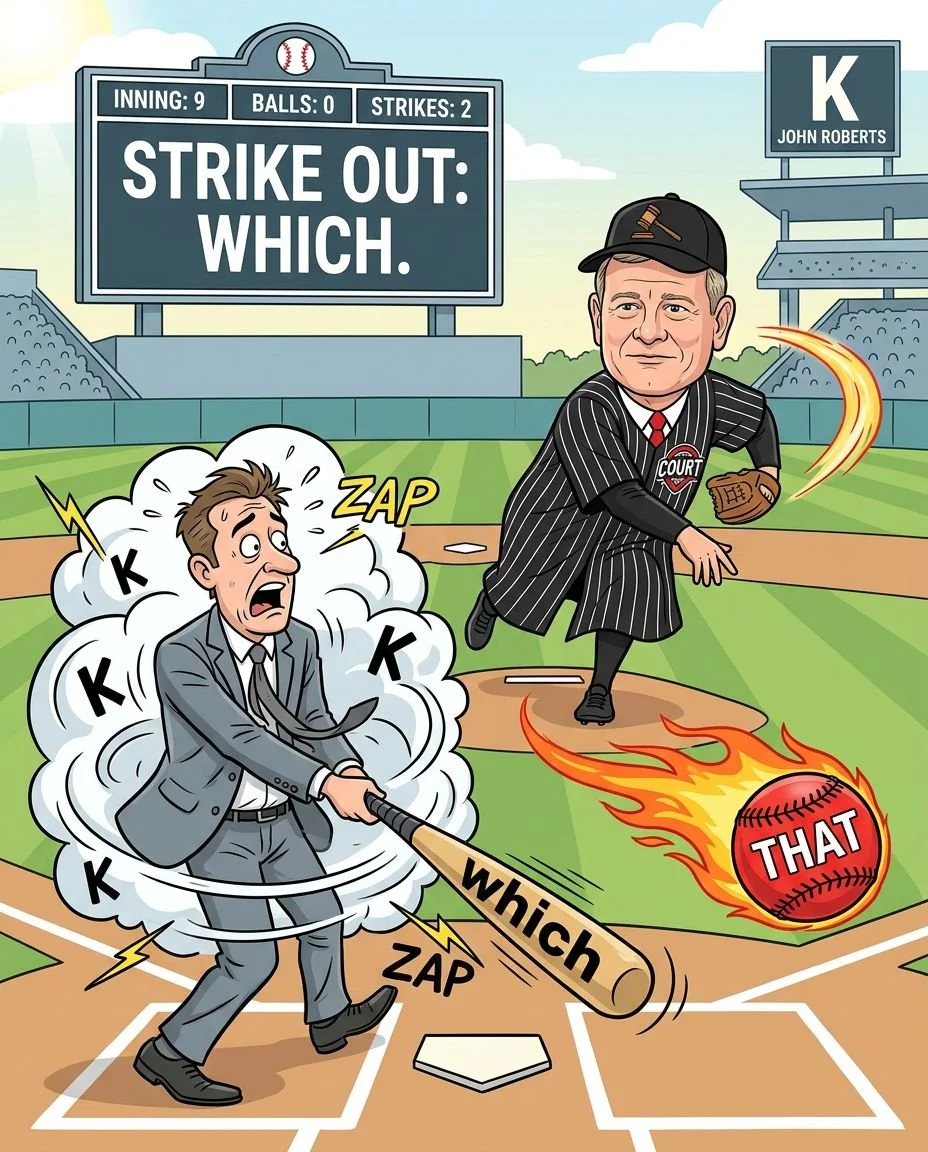
Dear Legal Writer: The solution to “which” vs. “that”?
Never use “which.”
That’s Chief Justice Roberts’s fix.
He hates the word “which.”
He’ll strike it out of your draft.(1)
I will, too.
Here’s why:
1️⃣ 95% of the time, “which” isn’t correct. (2)
Use “that” instead, and you can often omit it entirely.
❌ The brief, which the plaintiff filed, is too long. (3)
✅ The brief that the plaintiff filed is too long.
✅ The brief plaintiff filed is too long.
2️⃣ “Which” slows your reader down for no good reason.
“Which” always requires two commas—one before it and another one at the end of the clause.
And any time you have one of those two-comma clauses in the middle of a sentence, you ruin your reader’s rhythm and slow their pace.
Here are 2 better options:
1–Use a gerund in place of the word “which.”
❌ The last rule, which was confusing readers, delayed the deal.
✅ The rule confusing readers delayed the deal.
2-Convert the “which” clause into its own sentence.
❌ The last rule, which was confusing readers, delayed the deal.
✅ The last rule was confusing readers. It delayed the deal.
****
IMPORTANT:
The above has zero applicability to using “which” after a preposition, and Justice Roberts takes no issue with “which” in that context.
✔️ These are all correct:
“The job for which I’m applying . . .”
“The place to which I’m running . . .”
“The brief with which I’m futzing . . .”
💌 Amanda
#DearLegalWriter
P.S. Here are some attributions and notes for my fellow grammar geeks:
(1) When asked about this topic in Bryan Garner’s famed interview in or before 2010, Justice Roberts explained that using “which” instead of “that” creates a “dramatically different” reading experience, adding:
“[W]hen I see sentences with ‘which’ in them, it slows you down. . . . ‘That’ just seems to have better pace to it. I actually find you can usually go with the gerund that, again, is better for pacing. But ‘which’ is . . . I usually strike ‘em out.”
—13 Scribes Journal of Legal Writing (2007), at 38.
(2) Hat tip, Mark Hermann, “The Curmudgeon’s Guide to Lawyering.”
(3) “Which” is incorrect in the example because the plaintiff didn’t file every brief in the world, so you need “that” to indicate which brief you are referring to—i.e., the brief that the plaintiff filed.
If you’re bent on using “which,” you’d need to change the sentence to something like: “The plaintiff’s brief, which is too long, was filed,” but that’s clunky and sounds even worse.
***
⬇️
⚾️ Justice Roberts strikes out “which.” You should, too!!