Dear Legal Writer, Let’s get “i.e.” and “e.g.” straight, shall we?
I’m a bit of a Latin geek, but most aren’t, and “i.e.” and “e.g.” routinely cause mix-ups.
—In fact, it’s one of the top five mistakes ‘Grammar Girl’ says she sees in technical documents.
Both abbreviations are common in legal writing, too. You should just learn them now so you don’t have to look ‘em up every time. ⤵️
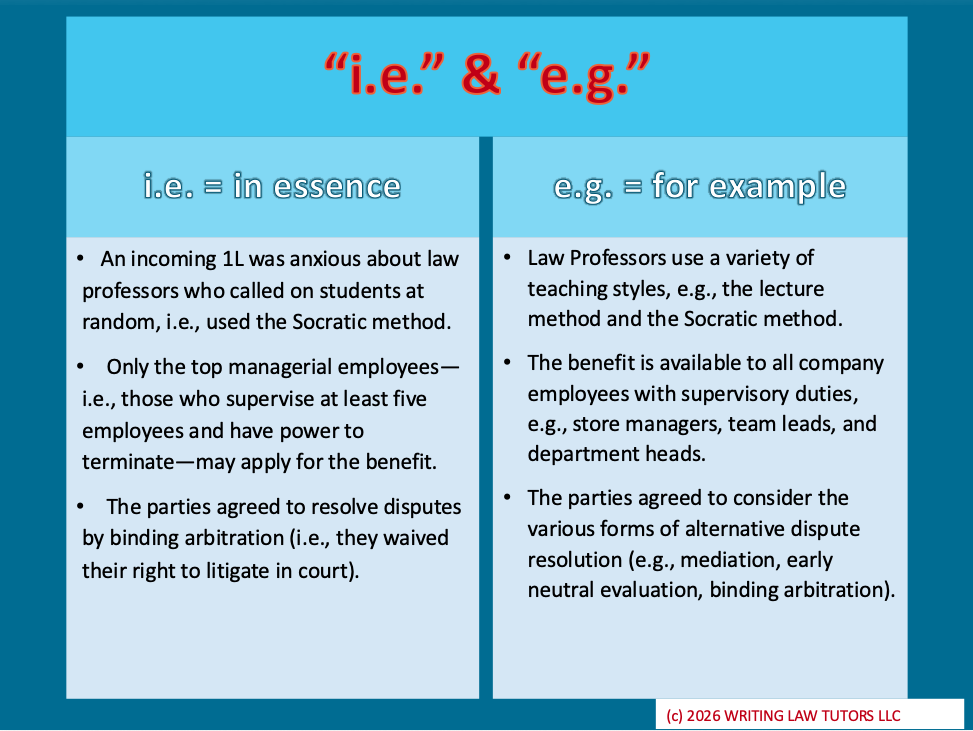
🔷 I.E. = IN OTHER WORDS
“I.e.” stands for “id est” in Latin, which is: “it is,” “that is,” or “in other words.”
You should use “i.e.” when you want to provide another way to say something you just said.
>An incoming 1L was anxious about law professors who called on students at random, i.e., used the Socratic method.
> Only the top managerial employees—i.e., those who supervise at least five employees and have power to terminate—may apply for the benefit.
>The parties agreed to resolve disputes by binding arbitration (i.e., they waived their right to litigate in court).
You might also say that the word(s) after the “i.e.” should restate or equate to the word or phrase right before the “i.e.”
🔷 E.G. = FOR EXAMPLE
“E.g.” in Latin means “exempli gratia,” or “for the sake of example.”
You should use “e.g.” after a word or phrase for which you’re introducing examples.
>Law Professors use a variety of teaching styles, e.g., the lecture method and the Socratic method.
>The benefit is available to all company employees with supervisory duties, e.g., store managers, team leads, and department heads.
>The parties agreed to consider the various forms of alternative dispute resolution (e.g., mediation, early neutral evaluation, binding arbitration).
Note that sometimes I omit the “and” before the last item in the list. Whether to include is a matter of personal style, and I’ve seen it done both ways.
🔷 PUNCTUATION
1. Periods. The style guides generally endorse including a period after each letter of both abbreviations—and that’s how I write them.
2. Commas. A majority of guides also advise using a comma both before and after the abbreviation—which I usually do, too, but have frequently seen done both ways. (Grammar Girl has compiled a handy table of what each style guide says in her blog.)
3. Parentheses. As the above examples show, you may set off an “i.e.” or “e.g.” phrase with a pair of parentheses, in which case, use NO COMMA before the abbreviation.
4. Em dashes. At least one style guide (i.e., Merriam-Webster) notes that “i.e.” and “e.g.” “can sometimes follow” an em dash, and I’ve seen them used that way.
🔷 MEMORY DEVICES
For “i.e.,” think “in essence.”
—Note that “in” is also the first word in “in other words,” the literal meaning of “i.e.”
For “e.g.,” which starts with “e,” remember “example.”
—Also, although “e.g.” does NOT stand for “example given” or “eggs given,” if either helps you remember what “e.g.” means, then remember it!
💌 Amanda
#DearLegalWriter