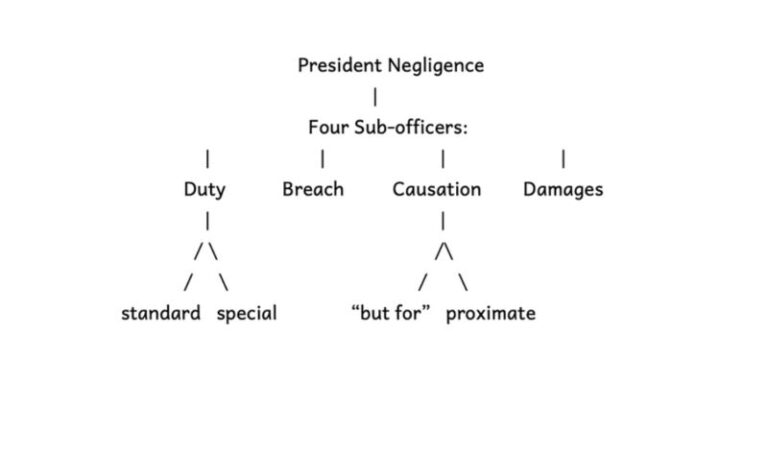

Dear 1L, Exam essays are like company org charts.
Dear 1L, Exam essays are like company org charts.
You should set up your essays that way.
To illustrate:
Imagine Negligence as a big corporation, “Negligence, Inc.,” that has a clear corporate hierarchy.
At the top sits the President, “Negligence” herself.
She demands that all of her 4 top officers be present before she will proceed with company business.
{In other words, all four negligence elements must be present for a claim to proceed.}
Directly beneath President Negligence sit four Senior Vice Presidents (“SVPs”), and each has an equally important role:
1-The SVP of Duty asks, “What’s our responsibility here?”
2-The SVP of Breach looks out for mistakes being made.
3-The SVP of Causation works to link mistakes to their effects.
4-And the SVP of Damages tells us if the mistakes had costs.
1️⃣ The SVP of Duty has two main deputies to whom he delegates all responsibilities:
A/ a Director of the Standard Care, who is a laid-back, “reasonable person” type with universal appeal, and
B/ a Director of Special Care, an intense perfectionist who often deals with experts and special circumstances.
2️⃣ The SVP of Breach works independently and has no direct reports.
3️⃣ The SVP of Causation has two critical team members that do all the SVP’s work:
A/ a Manager of “But For” Causation: A logical, straightforward thinker, and
B/ a Manager of Proximate Cause: A big-picture person who considers far-reaching consequences.
4️⃣ And finally, the SVP of Damages works all alone.
Once you’ve set up a chart like in the attached, you can organize your essay and make sure you don’t miss any issues by giving complete “IRAC” treatment to each of the lowest-level, “working” employees. 👉 I count 6:
1-Standard of Care
2-Special Care
3-Breach
4-“But For” Cause
5-Proximate Cause
6-Damages.
That means you must do a complete IRAC for each of these 6 issues:
1/ did D have any duty of care to P?
2/ was the nature of D’s duty specialized?
3/ did a breach of duty occur?
4/ was there “but for” causation?
5/ was there proximate causation?
6/ were there any damages?
👉 The key is to argue for BOTH the plaintiff and the defendant when you do the “Application” part of the IRAC on each of the 6 issues (assuming there is any reasonable, pass-the-red-face-test argument to be made; if not, say so and move on).
If it helps you to think of the “A” in IRAC as “Arguments” instead of “Application,” then please do so. This always helped me.
For my email subscribers, I go on to demonstrate how the full essay would be done. You can subscribe to get a copy and keep reading in the first comment.
***
I’m sending extra energy, brain power, and steadfast endurance to you.
I know how overwhelming all this early exam week seems.
💌 Amanda
#Dear1L