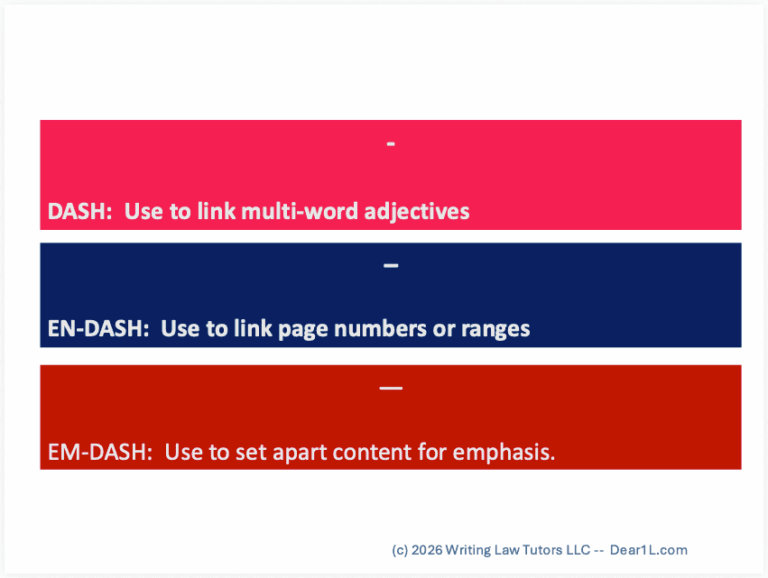

Dear Legal Writer, Hello to you, and DO-SI-DO. Today you become a 3-dash pro:
the hyphen (-),
the en-dash (–),
the em-dash (that’s 3!)
Check out below, and an expert you’ll be:
🔺 HYPHEN (-)
We’ll start with the hyphen,
and you can call it a “dash.”
It links multi‑word adjectives,
as in this little miss-match:
-“As a new college grad, you face a worse-than-ever-before job market.”
-“I am a 56-year-old author, teacher, and coach.”
-“It was a half-witted remark.”
The only wrinkle: pundits disagree on two-word nouns like “legal writing,” “summary judgment,” and “high school.” Some will hyphenate “legal-writing coach,” and others won’t. 💁🏼♀️
👉 I’m a “won’t.”
Chris Schandevel is a “will.”
What about you?
Please, won’t you spill?
🔺 EN DASH (–)
Next up, the en dash, short and sleek.
Use it to connect ranges of numbers, dates, or time spans,
and to show connections between geographic places.
Examples:
pages 12–17
1990–1996
March–July 2020
Monday–Friday
the New York–Pennsylvania border
the Cambridge–Oxford rivalry
🔺 EM DASH (—)
Finally, the em dash, the dramatic one.
It signals a break in thought, adds emphasis, and draws the reader’s eye exactly where you want it. It’s the most expressive of the three marks (at least until AI started stealing the show).
Here are 3 ways to use:
1. To set off words at the start or end of a sentence
Use the em dash to add emphasis—especially when a comma feels too gentle:
—“The Bluebook—love it or hate it—is every law student’s shadow companion.”
—“She passed the bar on her first try—a feat worth celebrating.”
2. To define, explain, or finish a thought
This use can give your conclusion more energy than a colon would:
—“The firm kept one value at its core—client trust.”
—“He wanted what every litigator wants—control of the narrative.”
3. To enclose mid-sentence asides that deserve more weight than commas
Paired em dashes work like parentheses, but make the aside feel livelier and more integrated:
—“The judge—usually unflappable—raised an eyebrow at counsel’s tone.”
—“This contract—unlike the earlier version—left no room for ambiguity.”
—“Our client—a small startup when we signed it—grew into a $10 million business.”
📍 Two Caveats
1: Use no more than one em dash—or one pair—per sentence.
Otherwise, readers lose the thread.
2: Don’t overuse them.
Dashes are like spice: a dash here and there adds flavor, but a heavy pour overwhelms the dish.
💌 Amanda
#DearLegalWriter
P.S. Some people spell en-dash and em-dash without a hyphen (en dash, em dash). Both are fine!
—> Will you try to use a dash the next time you write?
Try it out in a comment—if you’d like. 🙂